Italian POWs held in America during WW
II:
Historical Narrative and Scholarly Analysis
by Camilla Calamandrei
From June 1940 through May 1943, hundreds of thousands of Italians were
sent into a war for which they were ill equipped and about which they
understood little. By the end of 1943, over six hundred thousand Italian
soldiers were taken prisoner and, of those, 51,000 were brought to America
as enemy prisoners of war.
The documentary “Prisoners in Paradise” traces the journey
of six young
Italians: from their entry into the war; to internment as prisoners in
a
country with a level of abundance and wealth they had never imagined
possible; through a decision that would change not only their experience
as
prisoners in the United States, but in many cases, lead them to a second
decision that would change the course of their adult lives.
The first period of critical decision making for Italian POWs began
on September 8, 1943, with the announcement of the signing of the armistice
by
the Badoglio government in Italy. Now that Italy was officially an ally
of
the United States, Italian POWs were faced with the dilemma of whether
to “
collaborate” (i.e., perform war related work) with the nation that
had,
until that moment, been their enemy captor. To understand how confusing
this
concept was at that time, it needs to be noted that during this same
period
Northern Italy was still occupied by Germans who managed to free Mussolini
on
September 12th, and place him at the head of a newly declared fascist
republic. If these simultaneous contradictory scenarios are confusing
for us
to follow with fifty years of hindsight, one can only imagine how shocking
the shifting alliances must have been for young Italians who had only
recently been pulled from combat.
Looking at the data, it seems clear that Italians POWs in America were,
overall, sympathetic to the Allied cause. Almost 90% of the Italian POWs
agreed to support the U.S. war effort by joining what would be called
Italian
Service Units. This summary view unfairly disguises, however, the difficulty,
and in some cases trauma, of being asked to make this kind of decision.
If
these men had gone to war with the understanding that they didn’t
have to
believe in the war--they only had to believe in the greatness of Italy--then
what did it mean now to change loyalties? Did this constitute further
loyalty, in obeying the government of their homeland? Or, did it constitute
a
pathetic move to avoid being associated with the losing side? For young
enlisted men there were all these questions as well as: the fear of being
sent back into combat--possibly this time in Japan; fear of helping supply
munitions that would be used in Italy where their families might be in
harm’s
way; and fear of some kind of retribution against their families if it
became
known that their sons were helping the Allies. For Italian officers,
who
tended to be more indoctrinated in the ideology of fascism, changing
sides
was incomprehensible because it meant that there was no such thing as
the
courage of one’s convictions. Finally, for some individual enlisted
men and
officers who had fought side by side with Germans for two and a half
years,
there was also the simple question of loyalty to fellow soldiers.
Italian POWs were right to view the decision to support the U.S. war
effort
as a serious one. It would dramatically affect the quality of their
experience as prisoners in the U.S. And, in turn, for those who would
become
immersed in relationships and the abundance of life in America, it would
lead
them to the question after the war of whether they should live in Italy
or
seize the opportunity to build a new life under the flag of another nation.
The almost 45,000 Italian POWs who eventually agreed to join Italian
Service
Units were relocated, almost immediately, to coastal and industrial sites
across the United States. They worked with American civilians and military
personnel in combat related work for the remainder of the war. By contrast,
non-collaborating Italian POWs were kept in highly isolated camps in
places
like Texas, Arizona, Wyoming and Hawaii.
In addition to having jobs and earning money, men involved in the Italian
Service Units were given increased freedom of movement and as a result,
incre
ased interaction with American civilians. Across the country, there was
an
outpouring of interest on the part of Italian Americans who were looking
in
the Italian POW camps for relatives, family friends or simply people
from
their hometowns. As a result a number of Catholic parishes in many states
arranged to host dinners where Italian Americans could meet and visit
with
Italian POWs. These courtesies were extended almost exclusively to POWs
who
had agreed to support the war effort and even the freedoms granted these
Italian Service Unit members varied greatly depending on where they were
situated in the U.S.
Comparing and contrasting the experiences of Italian POWs on the East
Coast
with POW experiences in the mid-West and on the West Coast reveals that,
while their lives inside camp walls were quite similar, surrounding
communities had a strong influence on how much freedom POWs had to move
outside camp boundaries. It seems that community responses varied by
region
according to immigration patterns prior to the war, local politics, regional
economic realties and involvement and/or perspectives on the war. For
example, one might assume that the East Coast, because of its old world,
European connection and large Italian American communities, would have
been
the place where Italian POWs were received most sympathetically but this
was
not necessarily the case. While there were many Italian Americans who
wanted
to retain contact with the prisoners (by travelling to visit them on
Sundays)
it was generally accepted that this should be a relatively reserved activity.
The fact that these Italian POWs were contributing to the war effort
did not
erase the knowledge that Italy had contributed to escalating the war
in the
early years.
In contrast in the middle of the country, in states like Utah, Michigan,
and
Ohio, Italians serving in Italian Service Units had some modified privileges
and an unofficially sanctioned freedom of movement. POWs could be escorted
out of the camp by U.S. soldiers (which usually required a bribe) or
POWs
could sneak out of the camp and sneak back in, under an unofficial agreement
by which American soldiers would turn a blind eye. In Ogden, Utah a local
church held chaperoned dances each weekend for the POWs and Italian American
families could visit POWs on Sundays.
Finally in California, where the war was palpable through to the end
of 1945
because of the intensity of fighting in the Pacific, Italian POWs working
in
support of the war effort were actually received most enthusiastically.
While
local West Coast Italian Americans had felt some tension in their
neighborhoods early in the war (i.e., that they should not too openly
be
supportive or concerned about Italy) once Italy switched sides community
animosity turned more consistently to the Asians. As a result, Italian
POWs
had a rather significant amount of freedom in the camps in California.
The
most amazing story being that of the Italian POWs stationed on Angel
Island
who held regular dances in a hall in San Francisco that they rented with
their own money. In addition, Italian American families in California
could,
with official permission, take Italian Service Unit members out of POW
camps
for picnics and outings. It is important to note that immigration patterns
during the 20’s- 30’s in California set the stage for a sympathetic
reception of Italian POWs. Italians in the preceding decades had immigrated
in large numbers and established themselves as fisherman, farmers and
winemakers. In this state, heavily populated with immigrants from all
over
the world, by the 1940’s Italians were seen as relatively established
--especially in contrast with Asian laborers who were seen as a threat
to the
local “white” labor movement. Racism towards another group
took the edge off
racism or fear of the Italians. A point which actually refers to a larger
transition that was occurring for America during this period: the change
in
the perceived definition of who was a true American.
During WWII white ethnic Americans (e.g., Italian Americans, Jews, Irish
Americans) were drawn into a more integrated, accepted status as they
were
asked to go to war for their country and as they had the experience of
forming bonds, while in the army, across ethnicities and class. Early
in the
war Italian American communities were fiercely divided as it became clear
that some were embarrassed by Mussolini’s actions and others were
still
sympathetic to the fascist regime. In families where perhaps only the
father
had become a citizen when they first immigrated, wives and children quickly
moved to establish their American citizenship. With this as the backdrop,
we
see how Italian POWs and Americans were each facing their own questions
of
personal identity, loyalty and nationality during the period when they
were
called upon to work together for the larger Allied cause.
In addition to the stories of Italian POWs interacting with Italian
Americans, there were numerous situations in which Italian POWs developed
relations with Americans of diverse heritages (e.g., Italian POWs in
Colorado
and Nebraska were sent to do farm work for German American farming families;
in California and in New York POWs were guarded by Irish American guards).
In
a remarkable number of instances, the human impulses towards connection
and
camaraderie allowed the labels of “enemy,” “prisoner” and “foreigner” to
fade away and be replaced by life long bonds of friendship and love.
This was
credit to both the Italians whose vitality and good will flowed freely
and to
the Americans whose curiosity and humanity led them into vibrant, warm
relations with the Italian prisoners.
By the end of the war in December 1945, Italian POWs had contributed
millions
of hours to the war effort. When they were repatriated in January 1946,
a
number were leaving significant relationships behind—hoping, but
not sure,
that they would find a way to stay connected. Their joyous return to
the
homeland was, of course, tempered by the devastation evident throughout
Italy
and the realization that opportunities for young men returning from war
were
few. For Italian POWs who had not collaborated with the U.S., the return
to
Italy also meant coming to terms with the fact that in many cases friends
and
relatives had in the end decided to support the Allied war effort, and
the
non-collaborating position was no longer a popular one either officially
or
unofficially.
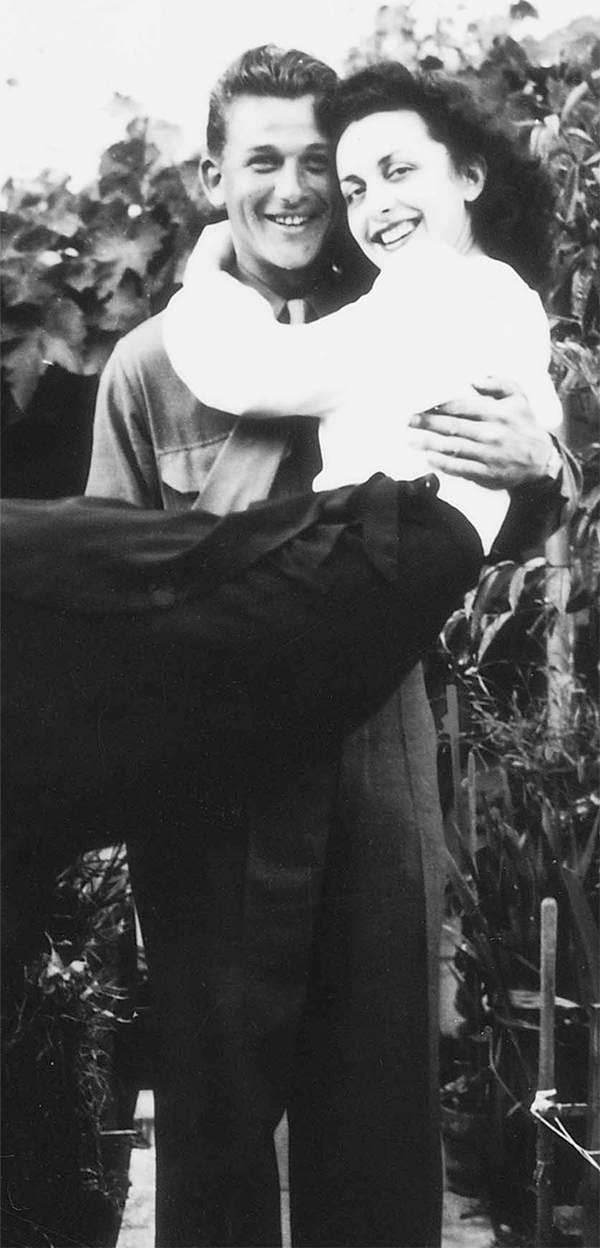
In the years following the war, some of the couples who had met in America
did decide to marry. In order to do that the American women had to go
to
Italy and marry there (because of quotas restricting immigration into
the
U.S.). Most often, due to financial difficulties in Italy, these couples
would return to raise families in the United States in the areas where
the
women had lived and where they still had jobs. We don’t know, officially,
how
many ex POWs chose to come back and live in America—but a number
of them do
now live as American citizens in the towns where they were first enemy
prisoners of war. Others (especially officers from the “fascist” camp
in
Hereford, Texas) have written books and created art about their experiences
in America, and have returned to visit periodically. Clearly the experience
of being a POW had a big impact on the 51,000 men who were brought here.
And,
they--in turn--had a big impact on all the lives they became part of,
whether
it was for the war years only or for the fifty years to follow.
copyright
2000, Camilla Calamandrei
Consulting Historians and Scholarly Advisors
for “Prisoners
in Paradise”
Janet E. Worrall Professor of History University of Northern
Colorado.
Specialization: Immigration history and Latin America. Author: “Reflections
on Italian Prisoners of War: Fort Wadsworth: 1943-46;” “Italian
Prisoners of
War in the United States: 1943-1945;” “Prisoners on the Home
Front:
Community Reactions to German and Italian POWs in Northern Colorado.” One
of
the few historians in America to have published articles concerning Italian
Prisoners of War in America, Prof. Worrall has been involved in research
on
Italian and German prisoners of War for ten years. She provides expertise
concerning hostility towards prisoners of War, existing textual material
from
the period (newspaper articles etc.), and issues specific to Prisoners
in the
Western part of the US as differentiated from those in the East.
Allan Kent Powell Historian, Utah State Historical Society. Specialization:
World War II. Author: “Splinters of a Nation: German Prisoners
of War in
Utah” University of Utah Press; “A German Odyssey: The POW
Journal of Helmut
Horner” Fulcrum Press; “Utah Remembers W.W.II” Utah
State University Press.
Dr. Powell is a specialist of W.W.II history in Utah and the West, with
specific emphasis on prisoners of war.
Stephen Fox Professor of American History, Humboldt State Univ., California.
Specialization in World War II (since 1983); Author: “The Unknown
Internment:
An Oral History of the Relocation of Italian Americans during World War
II”
Twayne Publishers, Boston, 1990. Work in Progress: “The Internment
of German
Americans in America during World War II.” Prof. Fox has been in
correspondence concerning this project since 1996. He provides expertise
on
Italian-American communities during W.W.II and on relations between Italian-Americans and the American Government preceding and during W.W.II.
Charles Wollenberg Professor of History at Vista
College, Berkeley, California. Specialization: Social History of California
during W.W.II.
Prof.
Wollenberg provides expertise in the history of Italian-American communities
on the West Coast, historic patterns of tolerance and/or hostility towards
immigrants, and detailed knowledge of homefront experience of World War
II.
Louis E. Keefer Author: “Italian Prisoners of War in America 1942-1946”
Praeger, 1992 and numerous articles about Italian Prisoners of War. Mr.
Keefer is extensively knowledgeable about the experience of the Italian
POWs
and of U.S. Army policy and practice during this period.
Robert Abzug Professor of History and American Studies, Director of
the Liberal Arts Honors Programs at the University of Texas in Austin.
Ph.D.
University of California at Berkeley, B.A. Harvard University. Author: “
America Views the Holocaust, 1933-1945: A Brief Documentary History”
(1998); “Inside the Vicious Heart: Americans and the Liberation
of Nazi
Concentration Camps” (1985). Dr. Abzug specializes in World War
II and
American Social History.
Mauro Calamandrei (Father of the filmmaker) Cultural Correspondent “Il
Sole
24 Ore,” Milan, Italy; Ph.D. Committee on Social Thought, Univ.
of Chicago,
Chicago; Ph.D. Philosophy, Univ. of Florence, Italy. Dr. Calamandrei
has been
both a Professor of American History at the University of Florence and
a
Visiting Professor of Italian History at the summer program at Middlebury
College. He has been the American correspondent for prestigious Italian
magazines and newspapers for 40 years. During W.W.II, Calamandrei was
a
student and then an active member of the anti-fascist underground in
Italy.
He has invaluable first hand knowledge of the cultural, psychological
and
economic conditions in the two countries. Calamandrei provides expertise
in
the areas dealing with historic patterns of Italian immigration to America
and economic conditions in Italy preceding, during and after W.W.II.
|